The worker's new hands

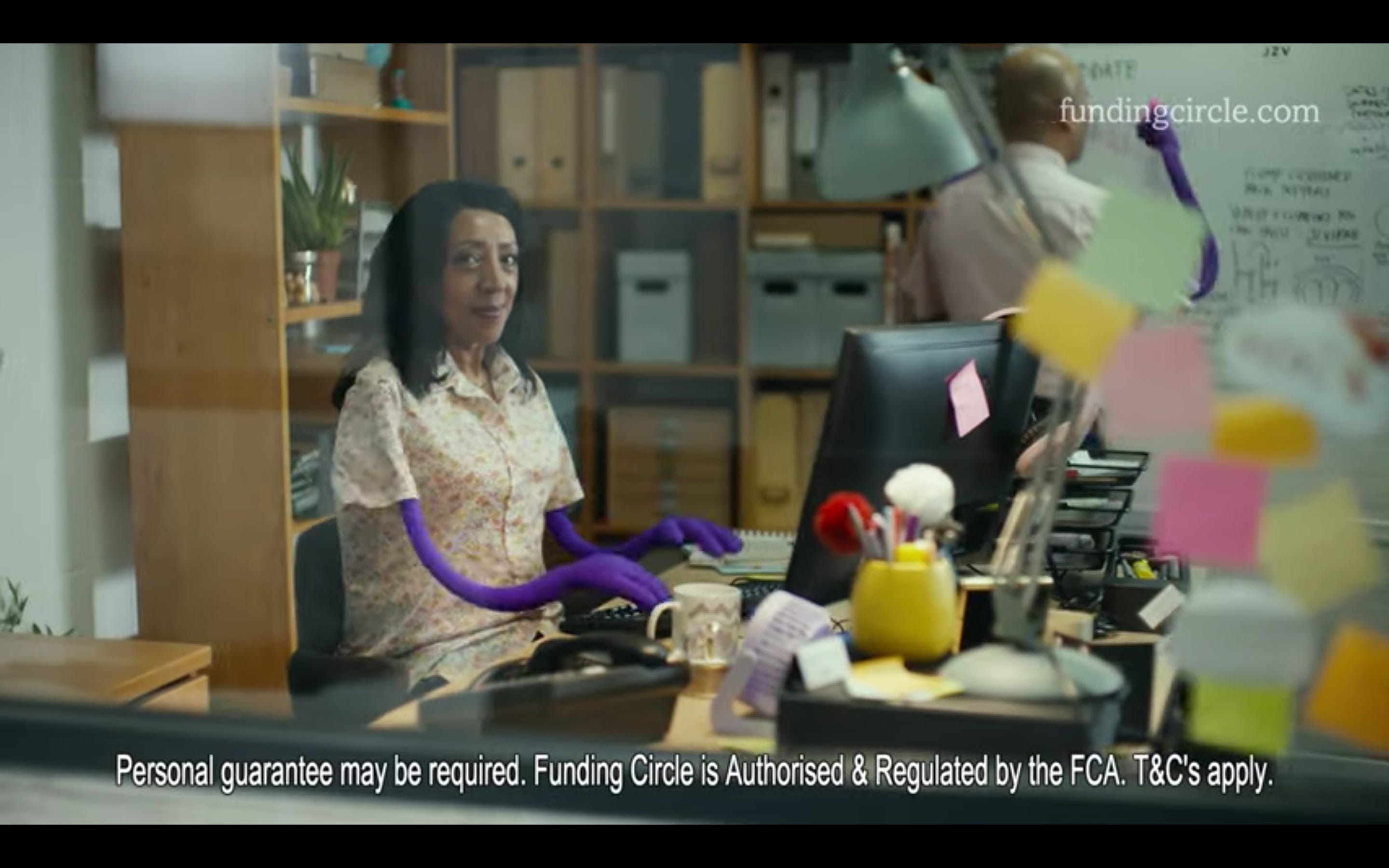
I don’t see many adverts on tv these days, but since I’ve been catching up on Channel Four’s excellent English Revolution drama (The Devil’s Whore), I’ve now seen commercial lender Funding Circle’s creepy ‘Lending Hand’ advert. We open with a young worker running through his office, panicked. His arms are crossed, with his shirt sleeves pulled up over his hands. He uses his shoulder to barge through a door and stumbles into the bathroom. His face in the mirror bespeaks horror. Cutting to a POV shot, he looks down. His arms and hands have been replaced by … skinny, purple, felt puppet limbs. His manager enters and the thriller score cuts out. He also has puppet arms. ‘It’s ok … we got a lending hand from Funding Circle.’ Now the wholesome swelling advert soundtrack kicks in, as our protagonist is toured round his workplace, showing that all of the employees have received puppet arms.

The employees in the advert are excelling at their jobs with the aid of their new hands, but the hands also have a strange will of their own. A typists’ hands tap with a propulsive rhythm at the keyboard but she smiles at the camera, looking away. A packer’s hands fling boxes perfectly onto a pile, but he too looks away. In this fantasy, replacing the employee’s fleshy arms with felt ones has brought harmony to the workplace. The workers are happy because they no longer have control of their bodies.
The advert functions as an allegory for the individual’s process of proletarianisation, the sequence by which ‘a certain change takes place in the physiognomy of our dramatis personae’ - a free subject goes in one side and a wage-labourer emerges out the other. The fatherly manager indoctrinates our worker into this new reality, and he quickly forgets the terror of the transformation. The folksy word play of ‘a helping hand’, as both a metaphor for a bank’s financial assistance and a literal ‘helping hand’, crafts the impression that a world ruled by money is something warm, familiar, that is a world in which the dominator’s fist wears a felt glove.
But, as with all ideological images, the facade of harmony is cracked. The advert grabs the viewer’s attention with the switch between genres, but the first sequence, the horror part, is excessive. The worker’s terrified visage, as he sees how his body has been modded by his company, lingers long after Funding Circle’s logo appears on the screen. The sub-sub-genre of Workplace Body Horror (think Sorry to Bother You’s human-horse hybrids, or Perdido Street Station’s terrifying body mod factories) reflects capital’s domination of the worker; the way it reforges you in its crucible, takes apart and re-assembles your being into something that fits into its system. The organic composition of the worker changes. Arms, once living, become dead labour, appendages of the machine that churns out value.